Monday, May 10, 2010

Out of the Sea - Ocean Fresh Fish

Out of the Sea…

Over the past few months, we’ve met many chefs who have talked about the lesser known varieties of great tasting fish. We came across a few on a recent trip to Ocean Fresh Fish & Seafood Marketing Inc in Los Angeles. We saw a lot of different types of fish and here’s a few that caught our eye:


Striped Jack or Shima Aji

Have I got a recipe to introduce you to…

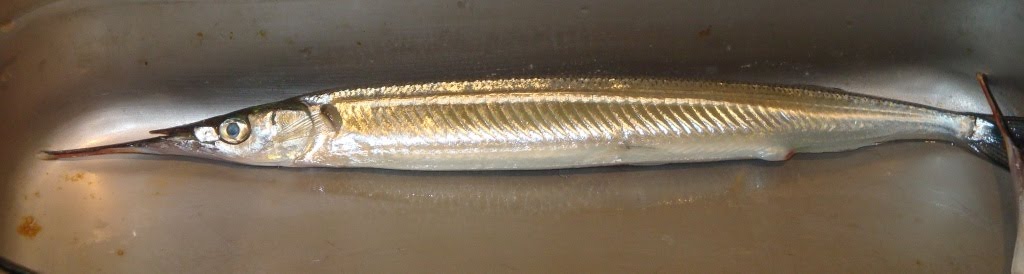
My All-Time Favorite – Spanish Mackerel


Unusual findings too…


So many chefs are talking about local sardines


UMI thanks Mr. Young Kim and Ocean Fresh Fish & Seafood Marketing Co., Inc for the visit, we’ll be back when we can spend more time.

We’re now off to try some different types of sushi and hope you do too, One Fish at a time…

Ocean Fresh Fish & Seafood Marketing Co., Inc.
1100 South Santa Fe Avenue
Los Angeles, CA 90021
(213) 622-3677

Article and Photos by Jay Terauchi and Jeffrey Nitta

Friday, April 9, 2010

A Hidden Sushi Gem - Sushi Hanada

When thinking about sushi in Los Angeles, a lot of well known celebrity places come to mind. We found a hidden sushi gem for some of the best sushi I've had outside of Japan, located about an hour North of Los Angeles.

We had the pleasure of being served by Chef Yuki Hanada of Sushi Hanada in Port Hueneme. You don’t find many traditional sushi places around anymore nor will you find a sushi chef that has the knowledge and experience that he has. Traditional sushi begins with the use of local fish and Chef Yuki uses the best possible local ingredients available.


Sashimi Course
Most people don’t understand is the importance of fish preparation; a good chef can bring out the flavor profile of seafood on so many levels. Chef Yuki is one of those master chefs who not only can create a beautiful dish, but also a very tasty one too.


(Left) Squid, Cherrystone Clam, Sea Eel

Chef Yuki’s doesn’t serve a lot of sushi rolls, so you won’t find rainbow rolls on the menu. But you will find some of the most flavorful fish and traditional sushi available. He's a true sushi master.

We thank Yuki-san for an evening filled with unbelievable sushi and great conversation. We’ll be back again…

(Left) Jay Terauchi, Nick Sakagami, Chef Yuki Hanada, Jeffrey Nitta
UMI will continue to introduce you to experienced chefs, One Fish at a time…
Please tell Chef Yuki that UMI says Hello!


Sushi Hanada
475 W. Channel Islands Blvd
Port Hueneme, CA 93041
(805) 984-7978

Wednesday, March 17, 2010

Edomae Sushi: How Today's Nigiri Sushi Began...

We don’t really know where sushi actually came from or who invented it. It can be said that sushi was a way to preserve fish and has been around for many centuries. Back then, whole fish would be salted and packed in steamed rice. A chemical reaction would occur and the fish would be preserved. Months later when it came time to eat the fish, the rice would be discarded and the fish eaten. Trevor Corson, author of “The Story of Sushi”, describes the taste of this early sushi as “pungent aged cheese, with butter and vinegar overtones.” It was much different than the pristine fish and rice that we enjoy today.

Edomae Sushi from the early 1800s

Description of the sushi above

This style of sushi dates back to the early 1800’s in Tokyo or Edo, as it was known back then. Edomae means “Tokyo Front” or Tokyo style of sushi with fish from Tokyo Bay. They used the local fish which they caught in the Tokyo Bay area. Majority of the seafood used was Sea Bream, Horse Mackerel, Squid, Mackerel, Tiger Prawns, Gizzard Shad, and many others. The sushi size (fish and rice) was much larger than today’s nigiri sushi and would be consumed in 2-3 bites.

Sushi was sold at stands around Edo (Tokyo), these stands were about the size of today’s hot dog carts. I guess you can say it was an early version of today's Fast Food. These sushi stands had a roof and a noren hanging over the stand, a cloth usually with the proprietor’s name on it. Back then, Zagat and Yelp weren’t around to help you decide where to eat. So you looked at the noren, the dirtier it was the better. Once customers finished with their sushi, they would wipe their hands on the cloth hanging above and go on their way. Hard to believe that sushi began in the streets.

Sushi originated from using local seafood. Ask your chef if they have any local fish and then try it, you might like it.

Continue to eat sushi and UMI will continue to educate you One Fish at a time.
Article by Jay Terauchi

Tuesday, March 2, 2010

"TUNA" on NHK World

The King of the Sushi Bar will be featured this Thursday (March 4th) on NHK World's "BEGIN Japanology". They'll take a look at Japan’s most popular fish, TUNA, and explore questions such as “As stocks decline and international quotas are adopted, can Japan’s voracious appetite for tuna be met through new methods such as breeding the fish from eggs?”

We'll be watching, will you? It shows that others are concerned about tuna too. Continue to enjoy sushi and follow UMI One Fish at a time. Arigato...

For more NHK World information on this program: http://tinyurl.com/ydmaln3

Monday, February 22, 2010

First Certified Fish Master in US


Congratulations to Tetsuya Nick Sakagami for being the First Certified Osakana Meister (Fish Master) in the United States. This Japanese course is for experienced fish and restaurant industry personnel and covers information dating back to the early centuries when fish was the main source of food and had to be preserved since there was no refrigeration. Back then, the Japanese invented methods to preserve fish and studied how bacteria interact with the human body. This Osakana Meister Program includes fish science, fishing practices, fish farming throughout the world, fish knowledge, crustaceans, shellfish, seaweed, processed seafood, health and safety, and seafood handling.

Currently, there are a total of 115 Osakana Meisters worldwide with one in the US. These Fish Masters have the knowledge and understanding of our ocean friends. UMI’s very own Tetsuya Nick Sakagami will be sharing his vast knowledge with everyone in the “Osakana’s Corner” at
www.uminpo.org.

Congratulations Nick! We hope to learn more from you One Fish at a time.

Tetsuya Nick Sakagami (Left) receiving his Osakana Meister Certification
For information on the Osakana Meister - Program: http://tinyurl.com/yaj2mq5

Thursday, February 18, 2010

Congratulations Logan Kock!


Congratulations Logan Kock on your promotion to Vice President of Strategic Purchasing & Responsible Sourcing, what a great resource Santa Monica Seafood has in you. It was a pleasure learning about Santa Monica Seafood and finding out how passionate you are about fish. With all of your ocean experience, you’re a true waterman and educator of the sea. UMI is proud to have a source like you with an unlimited background.

We’re happy to learn more from you One Fish at a time.


Logan Kock (Left) shows UMI's Nick Sakagami around the facility


Now that's a Lobster!
Photos by Jeffrey Nitta

Saturday, January 9, 2010

The Lone Fisherman

Just off the coast of Japan, Kouichi Mura looks out at the ocean. He’s not just observing the water, but he’s watching the height & direction of the waves, the level of the tide, the speed of the current, and feels the wind and rain on his face. He does this because he’s a fisherman. Mura learned fishing and the ocean from his parents, his father was a fisherman and mother was the on board assistant. When Mura was 1 month old, he went on his first fishing trip. He grew up wanting to be a fisherman and concerned with the preservation of the fish that he catches. I wonder if other fishermen feel the same?


Mura is that special breed of fisherman; his catch isn’t found at Tsukiji Fish Market, the biggest wholesale fish and seafood market in the world. His Suzuki (Japanese Sea bass) is highly-prized by many top chefs and restaurants and commands a higher price than other Suzuki. His fish are caught in areas where the seas are rough and the currents strong, not many fishermen go to these areas because of the harsh conditions, but Mura knows this area like the back of his hand. For Mura, these harsh conditions make for a stronger and tastier Suzuki.

Mura’s handling of the fish is a branded practice and very unique. His secret, he uses an air compressor when he preps his prized catch, something he developed on his own. Mura doesn’t give his catch the added stress when they’re caught. He keeps them alive in a tank aboard his boat and covers the tank at night with a blanket. A fish with less stress taste better and is why he can command a higher price from top chefs. Common sense says to consume fresh fish right away, but the way that Mura handles and prepares his fish, its best on the 3rd day. Even when his fish are shipped to restaurants in Tokyo, he carefully packs them with just enough ice to keep them at an optimal temperature and humidity.

Mura talks to chefs and restaurant owners and explains his methods. His prized catch can be found at many Michelin 3 star restaurants in Tokyo, like French restaurant, Restaurant Quintessens. Sukiyabashi Jiro, is arguably the highest rated sushi bar in Tokyo and a Michelin 3 Star restaurant. They wanted to try this prized Suzuki, the chef hasn’t used a good Suzuki in 20 years was amazed at the sweetness of Mura’s sea bass.

He’s a protector of the sea and its creatures, but understands the conservation of the fish that he catches; he only catches what he needs to put food on his table for his family. If he catches too much fish, the quality goes down. There needs to be a delicate balance in the ocean; well, I guess in our lives too. There are fishermen who care about preservation and how fish are treated. Mura said if he was a fish, he would be lucky to be caught by a fisherman like himself.

It’s good to know that there are still people out there who do it the right way… Let’s continue to eat sushi, One Fish at a time.
UMI thanks you for your continued support.